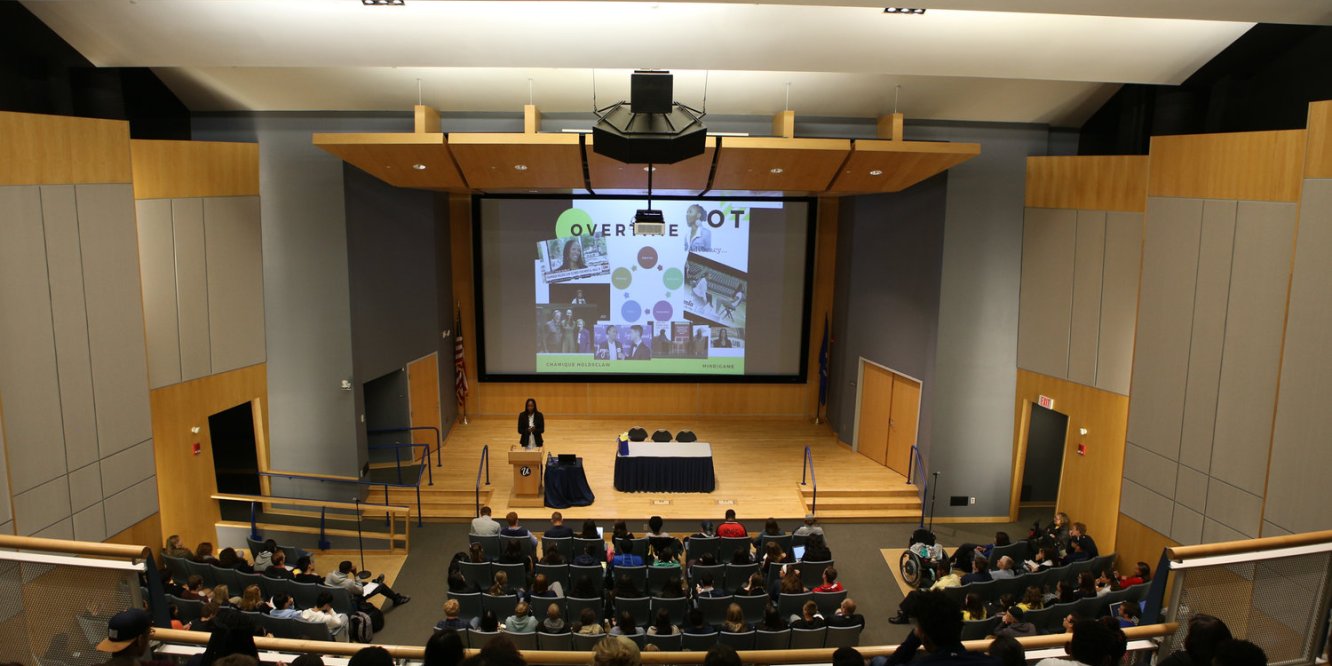
Former WNBA player and three-time NCAA champion, Chamique Holdsclaw spoke at the University of Connecticut during UConn’s suicide prevention week as a keynote speaker.
In her stirring speech, she invited the audience to look at her career that was entangled with her lifelong battle of mental illness. Holdsclaw nearly ended her career and life because she didn’t get the help she needed.
Now that she is comfortable with telling her story, she has become a mental health advocate and goes around the country to discuss her accomplishments, setbacks, and her path to finding mental stability.
“If you don’t ask for help you will not get it” said Holdsclaw.
Holdsclaw started her speech with her humble beginnings in Queens, New York City. There she lived with her parents who suffered from addiction problems. Since her parents were unfit to care for her, she was whisked away to her grandmother’s house in the projects. The social and financial change of going from a middle class environment to the projects took a toll on Holdsclaw. Said she had to find her own path to happiness and that was basketball.
“Basketball was my coping mechanism…my drug,” Holdsclaw said.
Basketball was an escape from her life and it made her happy. It gave her a chance to take out her temper tantrums on the court. Her time on the court was worth it because she had a chance to go to the University of Tennessee. There she won three national championships. Her coach, Pat Summitt, not only guided her the court but helped her transition from the diverse city of New York to a predominantly white university in Tennessee.
While in school, Holdsclaw’s grandmother updated her of her father’s mental state. She was informed that he was detained for hitchhiking, and was sent to a mental institution, after being diagnosed with schizophrenia.
Holdsclaw said she wanted to comprehend her father’s illness, but began to doubt her own sanity. Said she continued to resist to looking for possible treatment, due to ongoing stigma and stereotypes regarding mental health illnesses.
After graduating from the University of Tennessee, see was recruited to the WNBA to play for the Washington Mystics. Holdsclaw won the Rookie of the Year award but she said it did not satisfy her because her team failed to win many games.
Her depression worsened following the death of her grandmother, and she isolated herself from her teammates and social life, she said
Again Summitt came back to help her and after a visit Holdsclaw sought professional help. She started taking prescribed lithium as she continued to play professional basketball.
In 2007 Holdsclaw retired from professional basketball but then returned later for two more seasons until she had an injury that ended her career on the court.
Though her career was over, her mental illness still went on, she was losing control of herself. Holdsclaw said she didn’t know who I was anymore. She was at the edge and ultimately attempted suicide.
In 2012 Holdsclaw ended up in jail for attacking the car of a former partner with a baseball bat. Holdsclaw said being in jail allowed her to see herself at rock bottom. It gave her the time to reflect and influenced her decision to willingly seek help on her own. She said, the mental break led to her being diagnosed with bipolar disorder.
She said, as she received professional treatment and made healthier life choices, her depression does not take over her life anymore, she said. Since she has found mental stability she now has the strength to share her story across the nation.
“You are the new generation, the new voice,” Holdsclaw said. She reminded the students that they are the next generation and that they have to speak out about mental illness and seek help when they feel they need it.
The speech was well received by the audience it helped students think about mental health and its commonality among people. Jeffny Pally, 19, sophomore at UConn said,
“Really interesting especially because she is well known and decided to come to our school. It was brave of her to talk about her illness. I learned life is like a wave. “
The audience enjoyed how Holdsclaw stepped out of herself to expose her flaws Riya Abraham, 20, a junior at UConn said she enjoyed the talk.
“Different from other talks because she is humanizing herself despite how successful she became, she was being real with us,” Abraham said.
Imani Jean Gilles

 Imani Jean-Gilles